
Patios & Walkways
Flagstone, paver and brick laid on a base that will not settle — and pitched so the water goes away from your foundation instead of toward it.
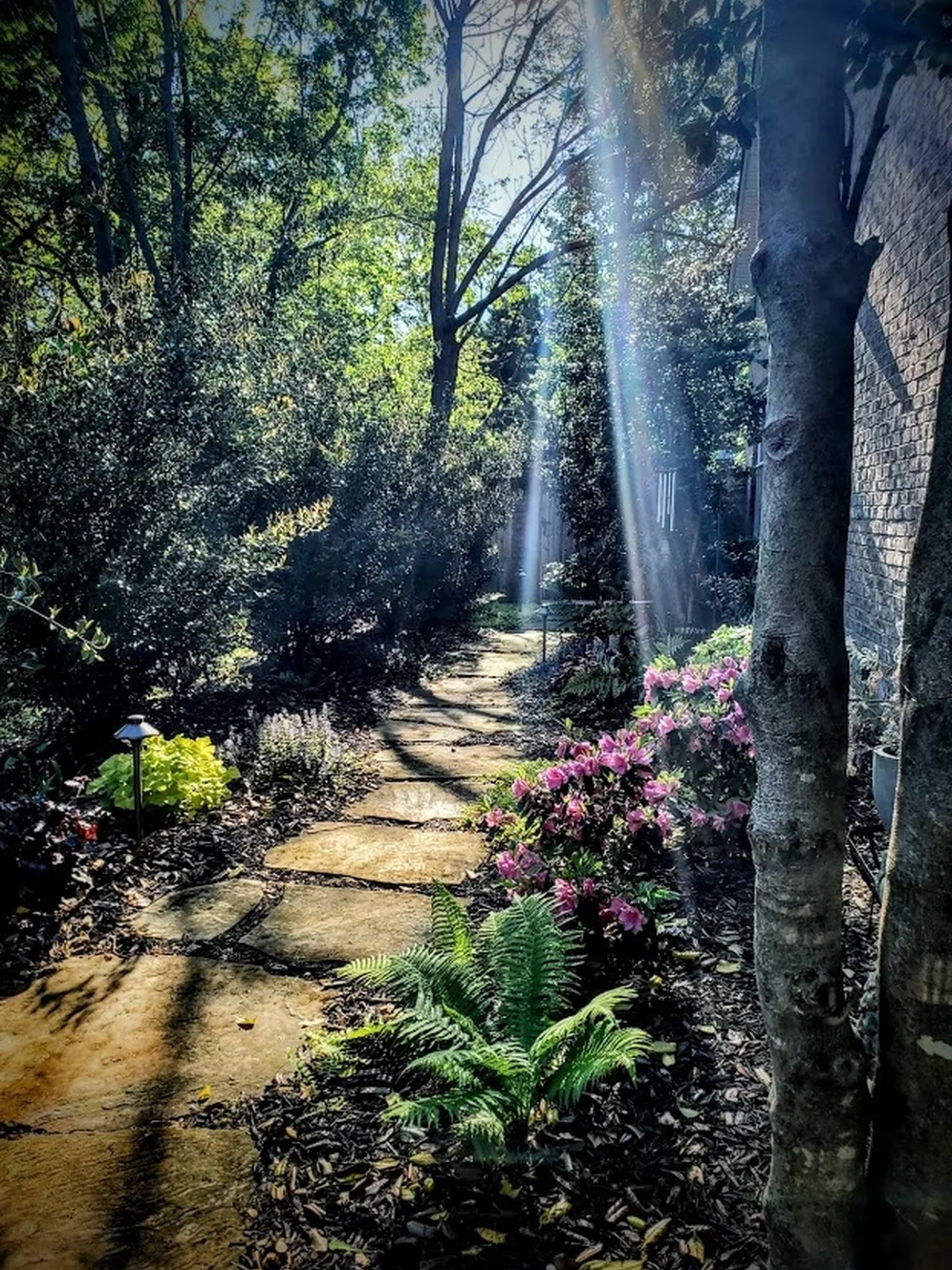
Flagstone Garden Pathway — A flagstone walkway threaded through azaleas and ferns along the side of the house, finished with low-voltage landscape lighting for evening use. Part of a full backyard build in the Upstate.
The base is the patio
A paver patio is only as good as what is under it. That means excavating to real depth, installing and compacting graded aggregate in lifts rather than dumping it all at once, then screeding a bedding layer to a consistent thickness.
Cut corners there and you get the thing everybody has seen: a patio that looked perfect the first summer and by year three has dips, rocking pavers and a low spot that holds water after every storm.
In Upstate clay this matters more than it does in sandier soil, because the ground underneath moves with moisture. We overbuild the base on purpose.
Getting the water right
Every patio gets a deliberate pitch — enough to shed water, not enough that your furniture wobbles. Where a patio meets the house we pay particular attention, because a patio that drains back toward the foundation is an expensive problem disguised as an amenity.
On tight lots or where the grade fights us, we build in a drain, a channel, or a dry creek to give the water a route it will actually take.
Flagstone, pavers or brick
Flagstone is irregular natural stone, hand-fitted. Nothing else looks like it. It costs the most and takes the longest, and on the right property it is the only right answer.
Concrete pavers are consistent, come in a wide range of colors and patterns, and give you the tightest joints. Best value per square foot for a large area.
Brick in a herringbone or basketweave field looks at home against older architecture and holds up well.
We build all three. Which one is right depends on your house, your budget and how the space will get used.
Common questions
How much does a paver patio cost around Greer?
Most patios we build run roughly $18–$40 per square foot depending on material, pattern complexity, site access and how much grading or drainage work is needed. Flagstone runs higher. Tim gives a firm number after seeing the site.
Will my patio settle?
Not if the base is built right. Settling is almost always a base failure — not enough depth, not compacted in lifts, or built on soil that should have been removed.
Can you tie a new patio into an existing deck?
Yes, and we do it often. The transition detail is where these projects usually look wrong, so it is worth doing deliberately.
Do paver joints need sand replaced?
Polymeric joint sand holds for years. Occasional topping up in high-traffic areas is normal and easy.
Can you build a patio on a slope?
Yes. Usually that means a low retaining wall or a terrace to create the level area, which is work we do anyway.